
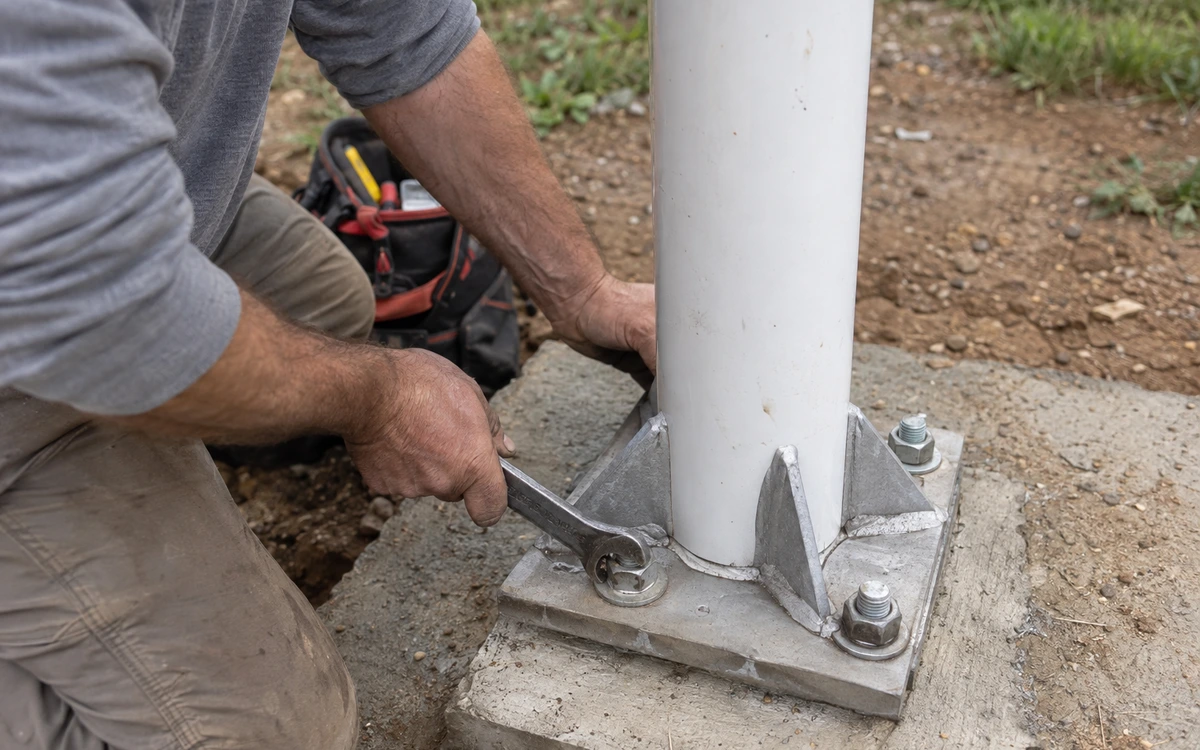
American Flagpole Crew is a flagpole installation company serving customers in all 50 states. American Flagpole Crew has been in business since 2013. American Flagpole Crew employs 66 flagpole installers. American Flagpole Crew has installed over 92,324 flagpoles across the country. American Flagpole Crew installs more than 11,641 flagpoles each year. We install in-ground flagpoles, wall-mounted flagpoles and flagpole lights.
American Flagpole Crew works with homeowners, schools and business owners. Our installers inspect the ground at each site and provide a written quote before work starts. We complete most flagpole installations in a single visit. American Flagpole Crew schedules appointments Monday through Saturday, 7 a.m. to 7 p.m. Contact us for a free quote today.
How Do You Know a Flagpole Needs to Be Reinstalled or Replaced?
The clearest sign is a pole that stays off plumb after the wind dies down. A sound installation returns to vertical every time, so a lingering lean usually points to the foundation, not the pole. Several other warning signs show up just as often, and each one points to a different part of the install.
- Pole leaning noticeably off plumb after storms
- Cracked or heaved concrete around the base
- Rust or a ring of pitting right at ground level
- Wobble or knocking inside the ground sleeve when you push the pole
- Flag wrapping and tearing within weeks of being hung
Why Does a Flagpole Start Leaning Off Plumb After Storms?
A lean that holds after a storm almost always means the footing has rotated in the soil because the hole was too shallow or too narrow for the pole's height. The standard rule is to bury about 10% of the pole's overall length, so a 20-foot pole needs roughly 2 feet in the ground, set in a concrete collar several times wider than the sleeve. When the footing is undersized, every gust levers the block a little further through soft or saturated soil, and it never fully settles back. To check, hold a level against two sides of the pole about 90 degrees apart. If it reads out in one direction and gets worse after each heavy rain, the footing is still moving and needs to be dug out and repoured.
Can You Just Patch the Cracked or Heaved Concrete Around the Base?
Patching won't hold, because the cracks are a symptom of the block moving, not the problem itself. Heaving usually comes from frost working under a footing that stops above the local frost line, or from a pour too thin to resist the pole's side load. A skim coat of mortar over those cracks breaks loose within a season or two because the block underneath keeps shifting. The real fix is to remove the old collar and pour a deeper footing that reaches below frost depth, which in cold regions can mean going several feet down regardless of pole height. Crowning the top of the new concrete so water sheds away from the pole also keeps ice from forming in the joint.
Does Wire-Brushing and Repainting Fix the Rust Ring at Ground Level?
Not on a steel pole that's already pitting. The band right at grade is where grass clippings, mulch, and standing water hold moisture against the metal, so it corrodes from the outside while condensation attacks the inside of the tube. Paint hides the surface, but the wall thickness is already gone, and that's exactly where the pole takes the most bending stress in wind. Press a screwdriver into the pitted area. If the metal flakes or dents, the pole is compromised and needs to be replaced, not recoated. Aluminum poles don't rust the same way, but they can still corrode if they sit in direct contact with steel or wet concrete without a sleeve or protective wrap.
What Causes a Knocking or Wobble Inside the Ground Sleeve?
That knock means the pole is moving inside its sleeve instead of being locked tight to it. Most residential sleeve installs center the pole with wood or plastic wedges, pack the gap with dry sand, and finish with a flashing collar or a bead of sealant. Over time the wedges shrink or rot, the sand washes out through the drain hole, and the pole starts rocking against the sleeve wall with every gust. That rocking wears both surfaces and can crack the concrete from the inside. Pulling the collar, setting fresh wedges, and repacking the sand is usually an afternoon's work. Check it again after the first winter, since new sand often settles and needs one round of topping off.
Will a Heavier Flag Stop It From Wrapping and Tearing So Fast?
Rarely, because the wrapping comes from the hardware and sizing, not the fabric. A pole with a fixed top instead of a revolving truck can't let the flag swing around as the wind shifts, so the flag winds itself around the shaft and shreds at the fly end. A flag that's too big for the pole drags and snaps harder; the usual guideline is a flag length of about a quarter to a third of the pole's height. Installing a rotating truck and a correctly sized flag stops most wrapping. Also check the halyard snaps and clips, because a loose rope slapping against the pole can wear through the flag's grommets in a few weeks.
How Much Does Flagpole Installation Cost in Bethlehem, PA?
Flagpole installation in Bethlehem, PA typically costs between $839 and $4,654 for a residential pole. Most of that range comes down to height and material: aluminum, fiberglass, or steel. Taller poles need a deeper, wider footing, so setting a 25-foot pole below frost depth takes noticeably more digging and concrete than a 15-foot pole in mild soil. Rocky or root-filled ground raises the price, as does pulling out an old pole and collar. Add-ons like a revolving truck or a solar light also increase the cost.